Community Impacts & Labor Pathways
Responsible offshore wind projects can help create strong agreements that protect local communities and workers. These agreements—like Community Benefit Agreements and Project Labor Agreements—make sure nearby communities and workers see real benefits, such as good jobs, local investments, and training opportunities. They also make sure community members and Tribal groups are included in the conversation from the very beginning and have a real voice in how projects are planned and built.
Community Benefit Agreements (CBAs):
CBAs are legally binding contracts between project developers and community groups or municipalities. They can provide funding and establish commitments to ensure that offshore wind projects deliver a range of community benefits, such as increased tax revenue, support for local supply chains and manufacturing, and the creation of jobs.
Project Labor Agreements (PLAs):
PLAs are pre-hire collective bargaining agreements between a contractor and one or more union labor organizations that sets the economic and employment terms for a specific project. Established before an offshore wind project begins, a PLA sets terms for work schedules, overtime, holidays, paydays, safety rules, and union rights, and can prioritize the hiring of local workers. PLAs are typically negotiated on a project-by-project basis.
As California’s offshore wind industry grows, it is projected to generate up to 65,000 construction jobs and 4,500 long-term operations and maintenance jobs, requiring a diverse range of skilled professions from longshoremen to engineers. This new industry presents a major opportunity to revitalize the Central Coast economy through high-wage jobs, career training, and community investment.
Offshore wind can and should benefit all Central Coast residents. The best way to ensure every voice is heard is to provide meaningful opportunities for impacted communities to engage in the development and planning process.
Here’s How You Can Get Involved
Sign up for CEC notices
Offer public testimony at hearings
Submit written comments
Attend webinars
Join the Sierra Club’s California Electric Sector Campaign by emailing Julia Dowell at julia.dowell@sierraclub.org
Sign up for email updates from the Environmental Defense Center
Sign up for Seabreeze, the National Wildlife Federation’s monthly newsletter, for updates on national and West Coast offshore wind developments

How will offshore wind development affect my community?
-
To prepare for offshore wind, ports in California are already investing in electrifying their operations, which will improve air quality as clean energy displaces fossil fuels and diesel.
The Ports of Long Beach and Humboldt will be where most of the staging and integration (turbine assembly) will take place. In contrast, the Port of San Luis and the Port of Hueneme are being considered for use as an operations and maintenance (O&M) hub, which involves little to no infrastructure buildout.
-
While offshore wind may not immediately lower energy bills, it will reduce the need for methane gas, which is subject to a boom and bust market cycle. Offshore wind also provides benefits in cleaner air, energy independence, diversification of the state’s energy resources, jobs and economic growth that will more than pay for the technology’s initial cost. As the transition towards clean energy progresses, affordability of offshore wind will only grow.
Offshore wind costs have dropped rapidly over the past few years. The Department of Energy (DOE) forecasts prices to fall to $53/MWh by 2035, making offshore wind cheaper than the levelized cost of a new combined cycle gas plant or coal plant. Renewables like offshore wind and solar will continue to get cheaper as the technologies expand, while fossil fuels will only become increasingly volatile and expensive.
As the offshore wind supply chain continues to mature and the market expands, prices are expected to decline even more.
By 2030, wind energy is estimated to be nearly 28 percent cheaper to produce over a project lifetime than the current levelized cost of energy (LCOE) for gas, which is projected to increase over the next decade.
The avoided costs of moving away from fossil fuels are significant: A California joint agency report estimated offshore wind could result in annual cost savings of approximately $1 billion.
-
California’s offshore wind industry is projected to create up to 65,000 jobs during the construction phase and up to 4,500 long-term operations and maintenance jobs.
Building an offshore wind industry requires the skills of many different professions, including but not limited to longshoremen, welders and engineers. The U.S. offshore wind industry is estimated to need up to 58,000 full-time workers annually between 2024 and 2030.
Harnessing the potential of offshore wind can help with the Central Coast’s economic revitalization by creating a booming new industry that provides high-wage jobs, benefits, and career training.
In the Central Coast, energy jobs have been a pathway out of poverty and into the middle class. With care and intention, we can ensure incoming jobs with the offshore wind industry offer the same or better work opportunities.

The Ports of San Luis and Hueneme are being evaluated for use as operations and maintenance (O&M) hubs, which involves little infrastructure buildout. The Port of San Luis received a $3M grant for a detailed study, but, to date, they have not accepted the funds.
In partnership with organized labor, the Central Coast organization Climate First: Replacing Oil & Gas (CFROG) has led the first West Coast implementation of an innovative offshore wind training.
CFROG collaborates with Tri-Counties Building & Construction Trades Council and Laborers’ International Union of North America Local 585 to introduce pre-apprenticeship students across the Central Coast to offshore wind and climate justice through a 5-hour course that utilizes innovative virtual reality (VR) technology. The pre-apprenticeship program has already prepared over 300 students across the Central Coast for jobs in offshore wind.
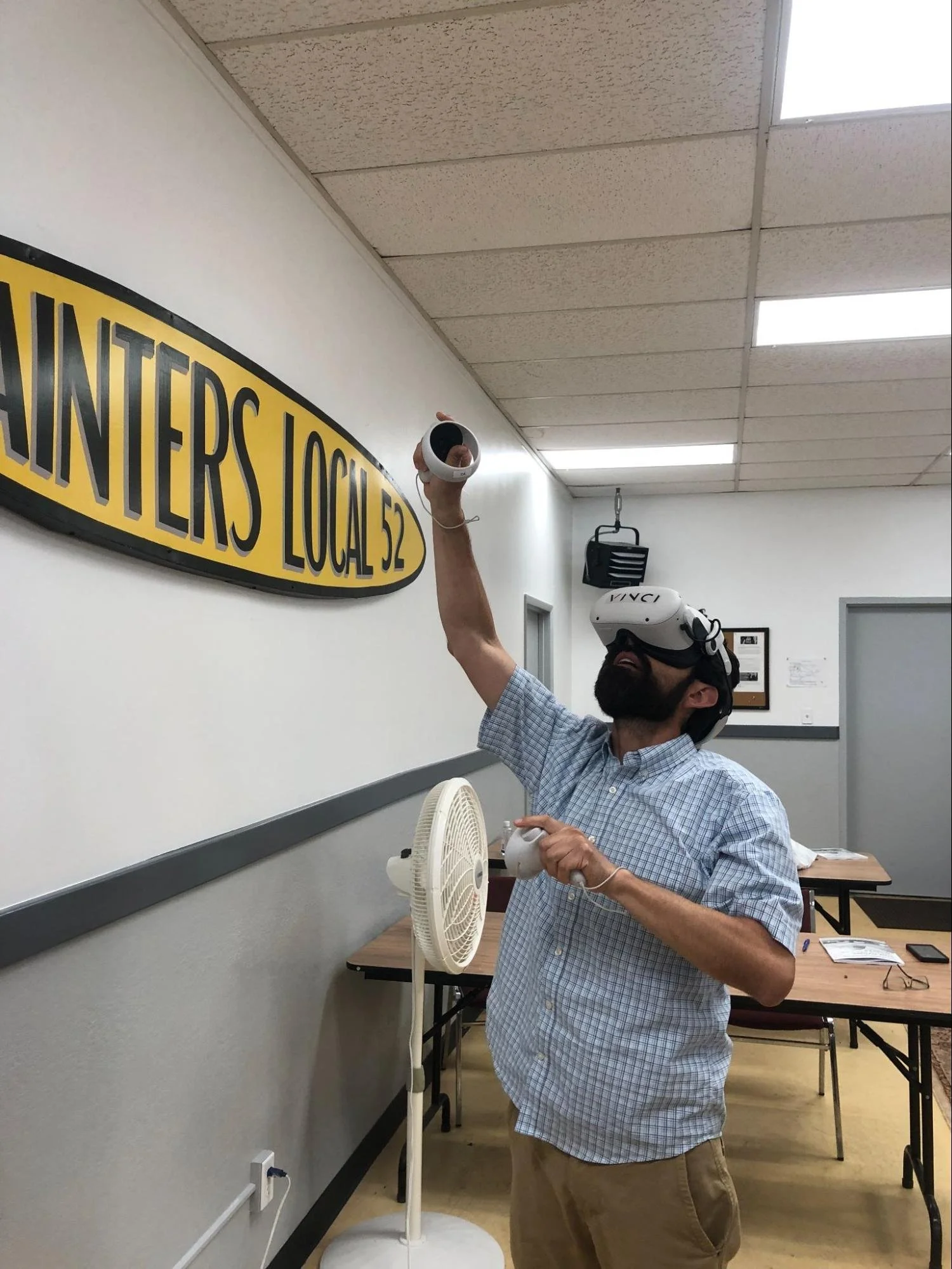
A pre-apprenticeship student participates in the offshore wind training program.